
我终于听懂了母亲的话Now I Know What My Mother Was Saying
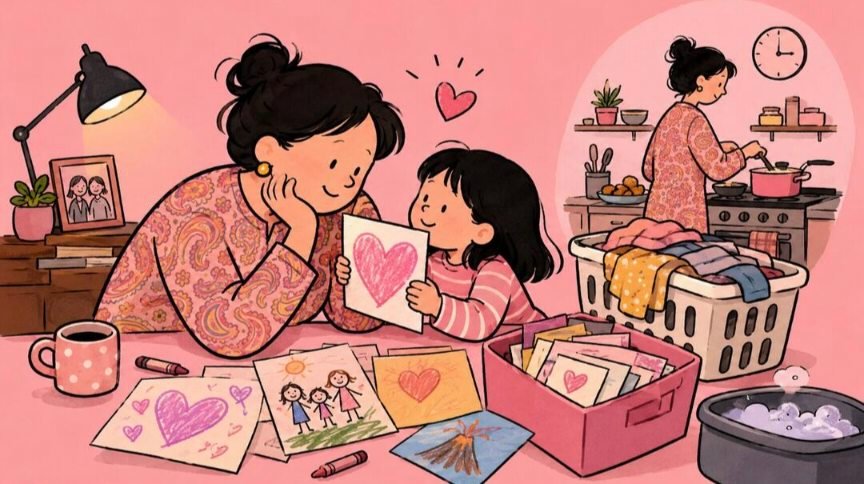
The kids’ folders come home from school fat with dead-stock papers: permission slips, notices, idle doodles, art projects, and completed packets of classwork. I sort through it all, checking their work before depositing it into the recycling bin. On my eldest daughter’s first day of kindergarten, I told myself I would keep scads of her schoolwork as mementos in boxes in the attic, but I underestimated how much there would be.
孩子们从学校带回的文件夹总是塞得满满当当:准假条、通知单、随手涂鸦、手工项目,还有成堆的课堂作业。我逐一翻看,检查完功课后便投入回收箱。大女儿上幼儿园第一天时,我曾发誓要把她的作品悉数收进阁楼的纪念盒里,但我低估了那惊人的数量。
在某个时刻,你必须接受一个残酷的教训:你无法留住一切。丢弃这些纸张在象征意义上是令人不安的,它像是一种物质化的恐惧,提醒着人们正眼睁睁看着与孩子共度的珍贵时光消散。我只能留下那些自认为重要的碎片来慰藉自己,比如所有的告白信。孩子只要学会识字,便开始书写爱。
“Dere mom,” a recent missive from my 5-year-old read. “I love you so much.” The text took up a whole page, was repeated on the back, and repeated again on a second sheet, each iteration in different shades of crayon, an adorable version of the typewriter scene in The Shining, as though repetition was all she had to convey the degree of her emotions. Of course, these are words that I taught her, and habits of expression I’ve modeled: I have told her that I love her every day since before she was born, an almost desperate need to express something too profound for words. This is an acute frustration. The love for one’s children is overwhelming, so intense that its attendant emotions often register as physical sensations.
“亲爱的妈妈,我超级爱你。”五岁女儿最近的一封信里这样写道。稚嫩的文字占满了整页,背面也是,甚至延伸到了第二张纸上。每一遍都换了不同颜色的蜡笔,简直像是萌版《闪灵》里的名场面,仿佛唯有重复才能表达她情感的浓度。当然,这些话是我教她的,表达方式也是我言传身教的结果:从她出生前起,我每天都会对她说”我爱你”。这是一种近乎迫切的冲动,想要表达某种文字难以承载的深情。这是一种强烈的挫败感,对孩子的爱是如此排山倒海,以至于随之而来的情感常具象化为生理感受。
I receive each of my children’s notes as a shot through the heart-not because I despair that they will someday cease but because the satisfaction of requited love is so transcendent right now. We have a closed circuit, a little private world: I shower them with all the love my soul can conjure, and they do the same for me. How to explain this love? It’s enormous; it’s animal;it’s amoral. The things I would do for the sake of this love emanate from some primitive, elemental place. I envision ochre paintings on torchlit cave walls: Did they feel this too, and how did they express it? I read once that most cave art was created by women and children. What did they say to one another?
每当收到孩子的便条,我的心都仿佛被击中–并非担心这种爱终将逝去,而是因为此刻这种双向奔赴的满足感实在太超脱了。我们拥有一个闭环的私人世界:我倾注灵魂所能凝聚的所有爱意,他们亦如是。该如何解释这种爱的量级?它宏大、原始、近乎本能。为了这份爱,我不惜付出一切,它源于某种原始而纯粹的根源。我联想到火光映照下洞穴岩壁上的赭石画:古人是否也有同感?他们又是如何表达的?我曾读到,大多数洞穴岩画出自妇女和孩子之手。他们当时对彼此说了什么?
When I was a little girl, I wrote messages of love for my mother on construction-paper hearts. Now I spend time contemplating more elegant ways to communicate that same sentiment, because the urge to write her love letters has not subsided. It’s taken on a certain urgency now that I understand the sacrifices she made for me. My mother used to pick me up in paisley dresses. She worked an eight-hour day with a long commute, then started a second shift at home, cooking demanding meals like fried chicken or biscuits and gravy. I used to sit beside her while she took her evening bath, watching while she rinsed her mascara off and finally breathed. As I got older, she would call from the office to ask me to prep dinner.
小时候,我也曾给母亲写爱语,把它们画在纸剪成的心形里。如今我开始构思更成熟的方式来表达同样的情感,因为给母亲写信的冲动从未消退。在我理解了她为我付出的牺牲后,这种表达变得愈发迫切。记忆中,母亲接我放学时穿着花呢长裙。她在经历了八小时工作和漫长通勤后,回到家开始第二轮轮班,烹饪费时的晚餐。以前她洗晚间浴时,我常坐在旁边陪她聊天,看着她洗掉睫毛膏,终于舒一口气。后来我长大了,她会从办公室打来电话,让我先帮着准备食材、预热烤箱。
Those requests annoyed me at the time, but they, too, were an expression of her love. The comedy of maternal love is that its seismic intensity is expressed, most of the time, in mundane drudgery. I would willingly die for you at any moment. Now come here and let me scrub popsicle residue off your face. I didn’t realize the practical cost until experiencing it. There are still the loads of laundry and the piles of dishes, and time taken to assist the kids in realizing tiny dreams: raising tadpoles, planting flowers, or crafting volcanoes. I didn’t grasp the force of feeling layered into all of that until I was the one doing the layering. It’s as though I’ve learned a language my mother spoke all along.
那时这些要求让我心烦,但它们同样是爱的表达。母爱的荒诞幽默在于,它那种如地震般强烈的震级,大部分时间却通过枯燥卑微的琐事来传递。”我愿随时为你赴死,但现在,过来让我把你脸上的冰棍渍擦干净。”直到亲身经历,我才明白这份爱的实际代价。生活依旧充满了洗不完的衣服和碗筷,还有为了帮孩子圆梦而花费的时间:养蝌蚪、种花、做火山模型。直到我也开始这种日复一日的堆叠,我才领悟到深藏其中的情感力量。这就像是我终于学会了母亲一直使用的语言,并终于读懂了她始终想表达的心声。
I’m falling in love all over again. I send my mother texts and flowers and invitations for trips just for us. But the words I find to speak aren’t ever equal to what I feel, and I don’t foresee that problem resolving; if anything, I suspect it will get worse as time goes on and my love continues to change and deepen. But perhaps the point of all these professions of love, of the notes in crayon and the loads of laundry, is to memorialize this feeling, not just communicate it. Every gesture means: Here and now, I feel something for you that is all-consuming and primordial, the full meaning of which can be revealed only over time.
我正重新陷入爱河。我给母亲发信息、送鲜花,邀请她参加只有我们两人的旅行。但我发现,搜寻到的词句永远无法与我的感受对等,而且我不认为这个问题能解决;如果说有什么变化的话,我怀疑随着时间的推移,这种爱会继续转变、加深,这种词不达意的感觉只会变本加厉。但或许,所有这些爱的告白–无论是用蜡笔写的字条,还是洗好的那一堆堆衣服–其意义并不在于沟通,而在于纪念这种感情。每一个微小的举动都在诉说:此时此刻,我对你的爱如此炽热而原始,其完整的真谛,唯有在漫长的岁月中才能逐渐显现。


