
我们只是宇宙舞台上微不足道的小角色We are minor actors on the cosmic stage
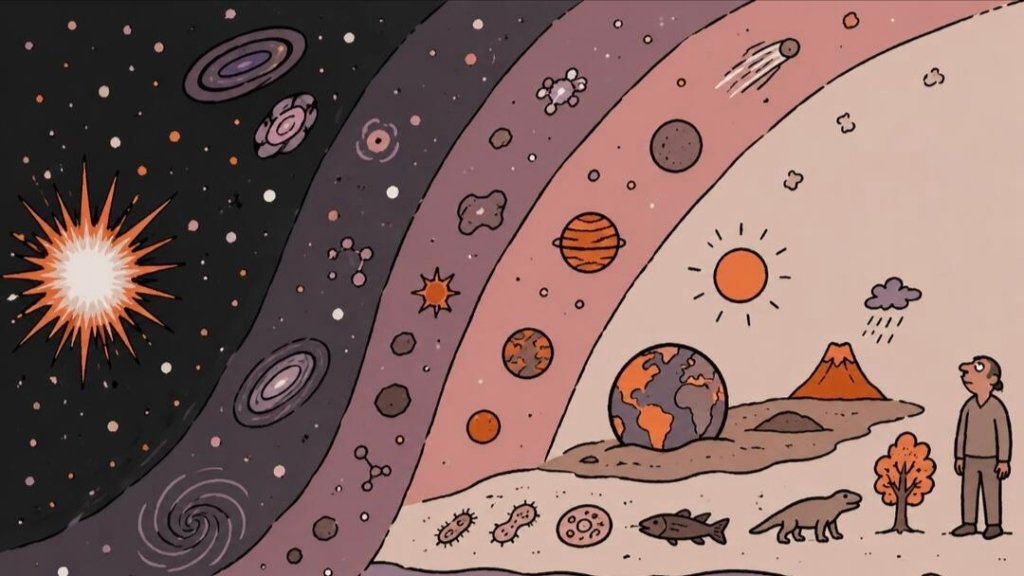
Humans arrived at the cosmic stage relatively late, in the last 0.01 percent of cosmic history. We are not at the center of stage, since we reside on planet Earth which orbits the Sun and the Sun orbits the center of the Milky-Way galaxy, which is one out of a trillion galaxies in the observable Universe. Given that we arrived late and we are not featured centerstage, the cosmic play is not about us. Yet, we can still ask how we got here. The cosmic play started in the Big Bang, 13.8 billion years ago. We can only trace our roots out to the distance travelled by light since then. This sets the finite size of the cosmic stage which is visible to us, and we do not know what lies beyond its horizon.
人类在宇宙舞台上登场相对较晚,仅仅出现在历史的最后0.01%的时间里。我们并不处于舞台的中心,因为我们居住的地球围绕着太阳公转,而太阳则围绕着银河系的中心公转,银河系不过是可观测宇宙中上万亿个星系之一。既然我们姗姗来迟,又不在聚光灯下,这出宇宙戏剧显然不是为我们量身定做的。然而,我们依然可以追问:我们究竟是如何来到这里的?这出宇宙戏剧始于138亿年前的宇宙大爆炸。我们只能追溯光自那时起所走过的距离。这划定了我们可见的宇宙舞台的有限范围,而在这地平线之外究竟隐藏着什么,我们一无所知。
On that stage, the initial conditions were remarkably synchronized to a part in 100,000. During the first 50,000 years of cosmic history, the mass budget was dominated by radiation. Subsequently, as the radiation cooled matter dominated, and small inhomogeneities in the matter distribution started growing gravitationally. The cosmic expansion of regions that were slightly denser than average was slowed down by self-gravity, leading ultimately for their turnaround and collapse into bound objects. The Milky-Way galaxy was one of these bound regions. The first generation of galaxies formed 50 million years after the Big Bang. Inside of them, gas cooled and condensed to make the first stars out of the primordial hydrogen and helium left over from the hot Big Bang. These stars were much more massive than the Sun, as cooling into smaller fragments was inefficient without heavy elements.
在这个舞台上,最初的条件表现出惊人的同步性,精度高达十万分之一。在宇宙历史的最初5万年里,质量收支由辐射主导。随后,随着辐射冷却,物质开始占据主导地位,物质分布中微小的不均匀性在引力作用下开始增长。那些密度略高于平均水平的区域,其宇宙膨胀速度被自身的引力所减缓,最终导致它们发生逆转并坍缩成束缚天体。银河系正是这些束缚区域之一。初代星系在宇宙大爆炸后5000万年形成。在这些星系内部,气体冷却并凝结,利用炙热大爆炸遗留下来的原始氢和氦,孕育出了早期恒星。由于缺乏重元素,冷却成更小碎片的效率极低,因此这些恒星的质量比太阳大得多。
The first heavy elements were synthesized inside these early fusion reactors. Within a few million years, the first massive stars exploded as supernovae and enriched their surroundings with the elements that enable life-as-we-know-it, such as the oxygen in water molecules or the carbon in organic molecules. Subsequent generations of stars enriched the interstellar medium further and eventually led to the formation of metal-rich stars like the Sun in the last third of cosmic history. The Sun formed 4.6 billion years ago. Inside the debris disk that was left from its formation process — dust particles settled to the disk midplane where they coagulated to make bigger and bigger rocks. These so-called planetesimals eventually grew in size to make rocky planets. One of these planets — the Earth — resided in the so-called habitable zone where liquid water could flow on its surface owing to atmospheric pressure.
首批重元素就是在这些早期的聚变反应堆中合成的。在几百万年内,早期的大质量恒星以超新星爆发的形式终结,并用维持我们所知生命存在的元素丰富了周围的环境。随后的几代恒星进一步丰富了星际介质,最终在宇宙历史的后三分之一阶段,孕育了像太阳这样富含金属的恒星。太阳形成于46亿年前。在其形成过程遗留的碎片盘中,尘埃颗粒沉降到盘的中面,并在那里凝结成越来越大的岩石。这些被称为微行星的天体最终逐渐长大,形成了岩石行星。其中一颗行星——地球——刚好位于所谓的宜居带内,在那里,得益于大气压的存在,液态水能够在其表面流淌。
An early collision of Earth with a Mars-sized impactor birthed the Moon which stabilized the spin of Earth. As the Moon receded, its growing orbit reduced Earth’s spin and the duration of a day grew from 4 hours to 24 hours. The soup of chemicals on Earth enabled the emergence of primitive life in the form of the Last Universal Common Ancestor (LUCA) 4.2 billion years ago. Complex life, in the form of early eukaryotes, appeared on Earth around 2.1 to 2.9 billion years ago, during the Earth’s midlife, roughly when Mars lost its atmosphere and surface liquid water to become a desert. Humans emerged only in the last few million years. This cosmic history should teach us humility.
早期地球与一颗火星大小的天体发生碰撞,诞生了月球,这稳定了地球的自转。随着月球逐渐远去,其不断扩大的轨道减缓了地球的自转速度,使一天的时长从4小时增加到了24小时。地球上富含化学物质的“原始汤”促使原始生命在42亿年前以“最后广泛共同祖先”(LUCA)的形式出现。大约在21亿到29亿年前的地球中年期,复杂生命以早期真核生物的形式出现在地球上,这大约与火星失去大气层和表面液态水并沦为沙漠的时间点相吻合。人类仅仅出现在过去几百万年里。这段宇宙历史应当教会我们保持谦卑。
We are minor actors on the cosmic stage and we exist because of everything that preceded us. Terrestrial life is fragile and could disappear once the delicate conditions enabling it will disappear as they did on Mars. Nobody would mourn the loss of humanity unless we make sure that our descendants travel to the stars where the history books are being written by the most accomplished cosmic survivors.
我们只是宇宙舞台上的次要角色,我们的存在仰赖于在它之前发生的一切。地球生命是脆弱的,一旦维持其生存的微妙条件不复存在,它就会像火星上曾经发生的那样灰飞烟灭。没有人会为人类的消亡而哀悼,除非我们确保子孙后代能够驶向星辰大海,在那里,出类拔萃的宇宙幸存者们正在书写着崭新的历史。


