
动物会打招呼但它们会说再见吗Animals Say Hello, but Do They Say Goodbye?
Jane Goodall, the late primatologist, was known for her imitations of chimpanzee greetings. When she met Prince Harry, she approached him slowly, making panting noises. She prompted him to pat her lightly on the head, then reached up for an embrace. Chimpanzees sometimes touched their lips together, breathed into one another’s open mouths, or stood on two legs and hugged. Greetings are found across the animal kingdom. Dogs sniff each other’s rears, African elephants swing their trunks, and songbirds peck at one another’s feathers. Orcas face off in rows before rushing into a sort of whale mosh pit, in which they slap tails, squeak, and whistle. When a bat wraps its wings around another bat, it seems to be communicating something familiar.
已故的灵长类动物学家简·古道尔因模仿黑猩猩的问候方式而闻名。当她与哈里王子会面时,她缓缓走近他,并发出喘息声。她示意他轻轻拍打她的头,然后伸出手臂与他拥抱。黑猩猩有时会嘴唇相碰,向对方张开的嘴里呼气,或者靠双腿直立并拥抱彼此。在整个动物界,问候行为随处可见。狗会互相闻对方的臀部,非洲象会甩动象鼻,鸣禽则会轻啄同伴的羽毛。虎鲸在排成一排对峙后,会冲进一种类似“鲸鱼狂欢”的聚集地中,拍打尾巴、发出尖叫与口哨声。当一只蝙蝠用翅膀环抱另一只蝙蝠时,它似乎在传达一种我们十分熟悉的善意。
On the other hand, were long understood as a behavior that only humans perform. In 2013, Goodall watched as a chimpanzee named Wounda was released to an animal sanctuary. Before walking into the trees, she hugged Goodall for several seconds. Some claimed the video showed Wounda saying goodbye, but institutes only described the embrace as “giving thanks.” The mystery of the missing farewells inspired many theories. Researchers suggested that goodbyes required cognitive abilities that many nonhuman animals might lack, such as planning for the future. “Why are you going to say goodbye if, upon return, no one remembers?” one primatologist noted. The study of leave-taking was simply assumed to be more complicated than greetings.
另一方面,告别长期以来被认为是人类独有的行为。2013年,古道尔注视着一只名叫文达的黑猩猩被放归至动物保护区。在走进丛林之前,它拥抱了古道尔长达数秒。有人声称这段视频展示了文达在进行道别,但研究机构仅将这个拥抱描述为一种“表达感谢”的方式。关于“缺失的告别”,其背后的谜团引发诸多理论。研究人员提出,告别需要许多非人类动物可能不具备的认知能力,例如规划未来。“如果对方回来时没人记得,那你为什么还要说再见呢?”一位灵长类动物学家指出。人们曾简单地假设,对告别行为的研究比对问候行为的研究更为复杂。
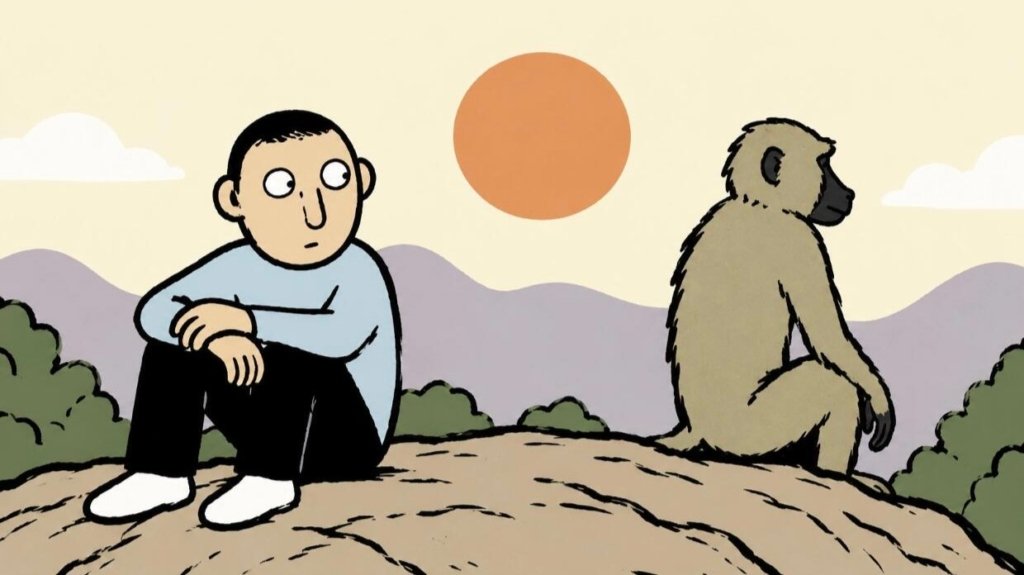
Primates were rumored to say goodbye at least a few times before recent studies. A gorilla in a Netherlands zoo is said to have kissed zookeepers before going inside her enclosure, and captive chimps sometimes share eye contact before ending activities. But researchers pointed out that these rare behaviors in captivity might only be imitations of human communication. Then, a breakthrough occurred. Researchers accumulated over sixty-five hours of footage from a national park in Mozambique, where baboons live in large groups. They noticed that baboons appeared to shift their bodies and gaze in the direction of an impending departure. They didn’t shift their bodies when alone. For these primates, this subtle gesture served as a definitive parting signal.
在近期的研究之前,就曾有传闻说灵长类动物至少有过几次说再见的经历。据说在荷兰一家动物园里,一只大猩猩在进入兽栏前曾亲吻过饲养员,圈养的黑猩猩在结束活动前有时也会进行眼神交流。但研究人员指出,圈养环境中这些罕见的行为可能仅仅是对人类交流的模仿。随后,一项突破性发现出现了。研究人员收集了来自莫桑比克一个国家公园超过65小时的录像素材,那里的狒狒生活在大型群体中。他们注意到,狒狒在即将离开时,似乎会转移身体方向和视线。当它们独自一人时则不会转移身体。对于这些灵长类动物来说,这种微妙的举动就是一种明确的离别信号。
If a human turned their torso slightly and walked off during dinner, it would be considered rude. For us, unique and terribly human interpersonal forces are unleashed when people say goodbye. Researchers note that goodbyes are often preceded by “explosive hand contact”—slapping one’s hands on a table or thighs—indicating the social effort required to part ways smoothly. One hint that the human goodbye carries real social weight is that we even have a name for its absence: to leave a party without saying farewell is to make an “Irish exit.” Goodbyes are highly contextual. My husband’s father will interrupt you mid-sentence on the phone to say, “Well, I should probably let you go now,” and then hang up.
如果在共进晚餐时,一个人稍微转动一下身躯就直接走开,这会被认为是粗鲁的。对我们而言,当人们互相告别时,会释放出极具人类特征的人际力量。研究人员指出,在说再见之前,人们通常会有“爆发性的手部接触”—用力拍打桌面或大腿——这表明了和平分手所需的社交努力。有个线索可以说明人类的告别承载着真实的社会分量,那就是我们甚至为“不辞而别”起了一个名字:在派对上不说再见就离开被称为“爱尔兰式告退”。告别具有高度的情境性。我丈夫的父亲在通电话时,会打断你说话,来上一句:“好了,我大概该挂了,”然后就直接挂断电话。
Goodbyes can be staggering in their variety. In the early twentieth century, on the Andaman Islands, locals took their leave from friends in a demure way: a person would lift their hand toward their mouth and blow air on it gently. Meanwhile, a farewell meal in China often includes long thin noodles to symbolize the winding road ahead. In China, people avoid cutting pears, as the word sounds like “separation” in Chinese. Many familiar goodbyes emerged surprisingly late; the handshake for “goodbye” didn’t become common in China until the 1970s. In the UK, farewells are known for their length. Just when you think it’s over, someone might restart the exhausting process.
告别的方式多种多样,令人惊叹。在二十世纪初的安达曼群岛,当地人与朋友告别的方式显得非常端庄:他们会把手举到嘴边,然后轻轻地向其吹气。与此同时,在中国的送别宴上,通常会有细长的面条,象征着前方漫长蜿蜒的道路。在中国,人们会避免切开梨,因为在中文里这个词与“分离”同音。许多我们熟悉的告别方式其实出现得惊人地晚;直到二十世纪七十年代,“再见”时的握手在中国才变得普遍。在英国,告别的过程以冗长而闻名。正当你以为告别已经完成时,某个人可能又会重新开始这个令人疲惫的过程。
Human goodbyes depend heavily on the strength of our bonds and our understanding of the future. When I parted with my best friend late last year, knowing I’d be away for months, we hugged close and said, “I love you.” Our relationship to time may be one of the most important differences between us and other animals. Cats and dogs act troubled when their people prepare to leave, whether by whining or curling up in an open suitcase. But they presumably can’t understand “I’ll see you in two weeks.” To a dog, our fervent and prolonged goodbyes at the front door might seem utterly impenetrable. Perhaps it would be better to give pets an Irish exit.
人类的告别很大程度上取决于我们之间纽带的强弱,以及我们对未来的理解。去年年底我与最好的朋友分别时,我知道我将有几个月见不到她。我们紧紧相拥,互道“我爱你”。我们与时间的关系,可能是我们与其他动物之间最重要的区别之一。猫和狗确实会迎接我们,当它们的主人准备离开时,无论是通过呜咽还是蜷缩在打开的手提箱里,它们都会表现出不安。但它们大概无法理解“我两周后见你”这句话的意思。对狗来说,我们在前门热烈而漫长的告别可能显得完全无法理解。也许对宠物进行一次“爱尔兰式告退”会更好。
Humans have a complicated history of assessing non-human animals. We sometimes overinterpret their behaviors, as seen in the past with supposedly talking horses. But today, we are prone to an overcorrection from anthropomorphism, automatically assuming animals lack certain capacities. Researchers are often so careful to differentiate humans from other species that they say primates have a “close social associate,” rather than a true friend. Yet, wild chimpanzees can plan where to sleep based on what fruit they want for breakfast. A male chimpanzee in Sweden hid rocks from zookeepers to throw at visitors the next day. Chimpanzees recognize individuals they haven’t seen for years. They possess a clear sense of absence, and researchers firmly believe that they have a sense of death.
人类在评估非人类动物方面有着复杂的历史。有时我们会过度解读它们的行为,就像过去那些所谓的“会说话的马”一样。但在今天,我们可能会对拟人化进行过度纠正,从而自动假设动物缺乏某些能力。研究人员为了小心翼翼地将人类与其他物种区分开来,他们会说灵长类动物有一个“亲密的社交伙伴”,而不是真正的朋友。然而,野生黑猩猩可以根据它们早上想吃什么水果来计划要在哪里睡觉。在瑞典,一只雄性黑猩猩把石头藏起来不让饲养员发现,为了在第二天扔向游客。黑猩猩能认出多年未见的个体。它们有清晰的缺失感,研究人员也坚信它们对死亡有认知。
If primates are capable of saying farewell, why wouldn’t they do it more obviously? Explanations vary. Long after two chimpanzees part, for example, they can trade vocalizations from one treetop to another. The species we are currently studying might simply not need to take leave in the same way. It is a striking thought—that other primates don’t need goodbyes as much as we do. Our farewells help us transition into a state of decreased access to one another. A goodbye manages the uncertainty of separation; it signals that you won’t be gone forever and that you’ll pick things up where you left off. Studying the animal kingdom reminds us how much we’ve complicated that message. For a baboon, maybe turning away is enough.
如果灵长类动物具备说再见的能力,那它们为什么不表现得更明显些呢?这有不同的解释。例如,在两只黑猩猩分开很久之后,它们仍然可以从一个树梢向另一个树梢交换声音信号。我们目前正在观察的这些物种,可能根本不需要以同样的方式进行告别。这是一种令人震惊的想法——其他灵长类动物根本不像我们那样需要告别。我们的告别帮助我们过渡到一种彼此接触减少的状态。告别应对了分离的不确定性;它是一个信号,表明你不会永远消失,最终你们会从中断的地方重新开始。对动物界的研究提醒了我们,我们把这个信号弄得多么复杂。对于一只狒狒来说,也许转过身走开就足够了。


